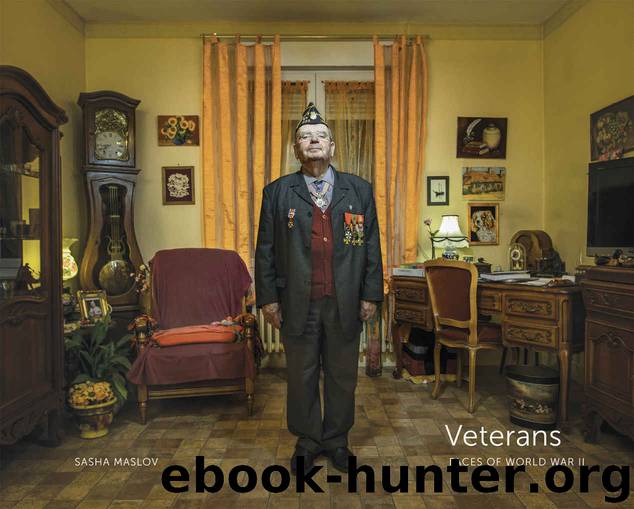
Veterans: Faces of World War II by Sasha Maslov
Author:Sasha Maslov
Language: eng
Format: azw3
Publisher: Princeton Architectural Press
Published: 2017-05-30T04:00:00+00:00
Uli John
FREUDENSTADT, GERMANY
I am Uli John. I was born on October 22, 1922, in southwest Germany. I had a peaceful childhood. I had a lot of fun around the village, with the boys and girls there. I lived on a farm. I loved the farmer’s work. Sometimes my father hit me for getting in trouble.
In 1940, I finished high school. Then I was a volunteer for the army. I was sent to Czechoslovakia for training, then to Poland. I was stationed in these places in the war: in 1941, Poland. In 1942, I was in the Russian campaign, where I became ill and was sent back to Germany on recreational leave. I attended an officers’ school in Berlin. In 1943, I went to France. In 1944, to Italy to the front against the Americans, in the fight for Rome. In the end of that year, I went to Belgium for the Ardennes offensive, and on December 31, I lost my left arm.
I got a letter: you must become a member of NSDAP.* I wrote a letter to my brother, who was also an officer in the war. He wrote me back: do not become a member of NSDAP, because we don’t know how the war will end. This was the same year.
There was an order from the highest levels of the army, from maybe Hitler himself. It said that all the injured should be amputated, people with legs injured, arms injured, because it would be faster than being treated in a hospital, so that the wounded could rejoin the fight. So four weeks later, amputees would be at the front again. After an operation in 1945, I went back to Germany to the final fight against the Americans.
The soldiers on the front lines had no idea what was happening at home. We were told that we weren’t going to war against America or against France. We were going to rescue the homeland. This was told to soldiers across the fronts because soldiers were often apolitical. Perhaps many of us were of good intention, doing wrong things.
I remember once, on Christmas Eve, in Russia, the soldiers were throwing presents they’d gotten from home to each other, across the lines. There was still gunfire, but it all went high, for show. The packages were full of sweets or cakes, small things sent over from home. Cigarettes, perhaps. A symbol for the holiday.
The last year of the war was a real mess. I was an officer, commanding my unit, and I did something forbidden: I dissolved it. I wrote everyone passes, for groups of two or three people, one weapon among them, so that they could get home. I could have been shot for this, but I did it because the war was ending and I felt that they needed to get home. Everyone made it back. I traveled with a bicycle and on foot from a French zone, which became an American zone at the end of the war, not far from Bavaria.
Download
This site does not store any files on its server. We only index and link to content provided by other sites. Please contact the content providers to delete copyright contents if any and email us, we'll remove relevant links or contents immediately.
| Africa | Americas |
| Arctic & Antarctica | Asia |
| Australia & Oceania | Europe |
| Middle East | Russia |
| United States | World |
| Ancient Civilizations | Military |
| Historical Study & Educational Resources |
The Radium Girls by Kate Moore(12094)
100 Deadly Skills by Clint Emerson(4972)
Rise and Kill First by Ronen Bergman(4838)
The Templars by Dan Jones(4737)
The Doomsday Machine by Daniel Ellsberg(4552)
The Rape of Nanking by Iris Chang(4258)
Killing England by Bill O'Reilly(4042)
Stalin by Stephen Kotkin(4006)
Hitler in Los Angeles by Steven J. Ross(3981)
12 Strong by Doug Stanton(3579)
Hitler's Monsters by Eric Kurlander(3385)
The Code Book by Simon Singh(3251)
Blood and Sand by Alex Von Tunzelmann(3240)
Darkest Hour by Anthony McCarten(3161)
The Art of War Visualized by Jessica Hagy(3043)
Hitler's Flying Saucers: A Guide to German Flying Discs of the Second World War by Stevens Henry(2777)
Babylon's Ark by Lawrence Anthony(2718)
Tobruk by Peter Fitzsimons(2559)
The Second World Wars by Victor Davis Hanson(2554)
